

What we can do for you
Double-eyelid creation
We discuss natural-adhesion and incisional approaches. The choice depends on tissue characteristics, the desired crease and the surgeon’s assessment. Natural adhesion does not mean no surgery or no scar risk.
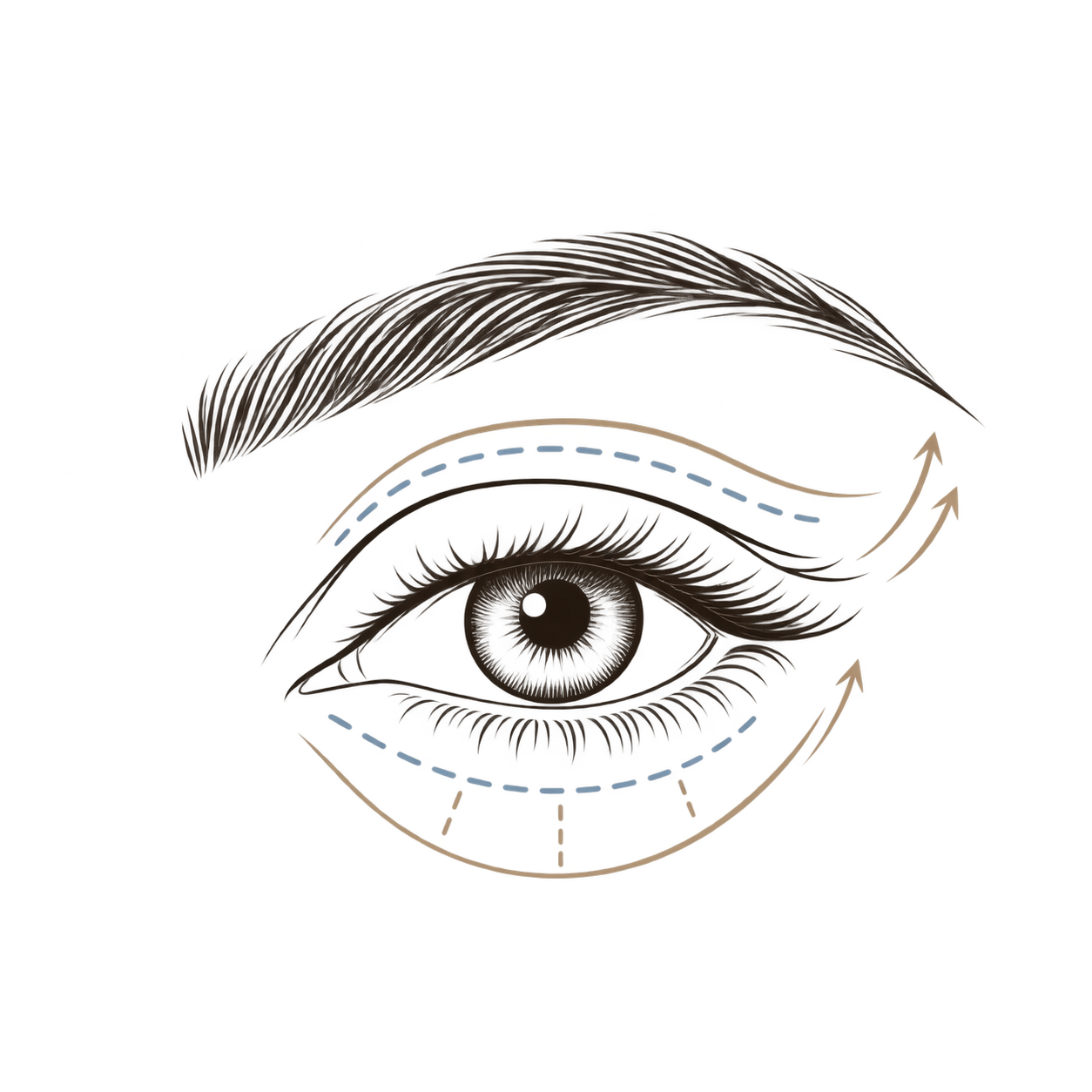
Eyelid-opening correction
A low upper-lid margin, heavy appearance and a high crease are not automatically the same problem. Your consultation separates possible ptosis, excess skin and brow contribution before discussing an operation.
Canthal procedures
Medial or upper-medial canthal work and lateral or lower canthal work address different areas. Your surgeon will explain the technique, incision status, direction and scar expectations for your plan.
Under-eye and age-related options
Under-eye fat repositioning, skin-related options and brow or upper-lid questions are not interchangeable. We tailor the plan to the tissue, function and concern you want to address.
Revision eyelid surgery
A revision consultation needs the previous operation, timing, materials and current findings. Your surgeon will explain timing, fees and the likely scope of correction for your case.
A clearer starting point
Start with the question, not the procedure.
The same “heavy” or tired appearance can involve different structures. These four questions help organise a consultation without turning a concern into a self-diagnosis.
Crease
We discuss visibility, origin, height and curvature. Crease design is a different question from how widely the eye opens.
Ask your surgeon: what kind of crease would suit my tissue and goals?Lid opening
We separate a low upper-lid margin or eyelid-opening concern from crease creation alone.
Ask your surgeon: does movement or function affect my plan?Skin and brow
We consider upper-lid skin and brow position alongside the crease so a heavy-looking eye is understood in context.
Ask your surgeon: could skin or brow position be part of the picture?Under-eye contour
We separate fat, skin, hollowing and shadow when discussing lower-lid contour.
Ask your surgeon: is the concern contour, skin, shadow or more than one?Choosing an approach
Natural-adhesion and incisional methods answer different questions.
We discuss both approaches, but the choice depends on your tissue, the crease you want and your surgeon’s assessment. Neither label means no surgery or guarantees a particular result.
| Approach | What it may help clarify | What it does not decide |
|---|---|---|
| Natural-adhesion | A smaller-opening or suture-based approach may be discussed when tissue and the intended crease make it appropriate. | It is not “no surgery” or “no scar,” and it is not suitable for every eye. |
| Incisional | An incision can allow the surgeon to discuss selected tissue management and fixation in more detail. | The label alone does not determine the method, result, recovery or risk for an individual. |
Recovery in milestones
Recovery is a sequence, not one fixed number.
Use these milestones to prepare your questions; your surgeon will tailor recovery guidance to the operation performed.
- 01
Early changes
You may notice swelling, bruising, irritation or dryness early on. Bring any concerns to your surgical team.
- 02
Social recovery
Many patients are more presentable around 10–14 days.
- 03
Longer healing
Final settling can take longer. Ask your surgeon about work, exercise, travel, eye protection and follow-up before booking around a deadline.
Questions to bring
A useful consultation leaves room for uncertainty.
Is my concern the crease or the lid opening?
Ask the surgeon to separate crease design from eyelid movement, function and comfortable closure before a method is discussed.
Could skin, brow or under-eye tissue be contributing?
Ask which structures were assessed and which concern each proposed option is intended to address.
What should I bring for a revision consultation?
Bring the history of previous operations, approximate dates, available records or implant information, and your current concerns.
Technology in context
Use analysis to support a conversation, not replace one.
At VAVA, we use VETI to discuss inter-eye spacing, medial crease origin, crease height and crease curvature. Anigma can support that conversation by helping us look at the features that shape an eye-area plan.
How VAVA uses VETI and Anigma
At VAVA, we use VETI to organize an eye-area conversation around four planning dimensions: inter-eye spacing, medial crease origin, crease height and crease curvature. This framework helps your surgeon compare the features that shape your plan and explain which details matter for your goals.
How suitability is discussed
Your consultation can consider what you notice, eyelid position and movement, skin redundancy, brow contribution, ocular-surface symptoms, facial proportion, previous surgery and the result you want to protect. A celebrity photograph can help describe a preference, but it cannot define the operation or reproduce another person’s features exactly.
Recovery and limitations
Plan for early swelling, bruising, irritation or dryness. Many patients are socially presentable around 10 to 14 days, while complete healing takes longer and varies by procedure and person. Follow your surgeon’s instructions for compresses, ointment, protection, makeup, contact lenses, exercise and follow-up.
Risks to discuss
Your surgeon will discuss risks including dry or irritated eyes, difficulty closing the eyes, bleeding, infection, visible scars, altered sensation, asymmetry, lower-lid malposition and further surgery. Protecting eye closure, ocular-surface health and function comes first.